The Ancestral Voices Launch Series

Ancestral Voices is a platform dedicated to collective healing, truth-telling, and restoration for Black people across the global diaspora. We confront the psychological, cultural, and spiritual wounds inherited from slavery and colonialism, not to dwell in pain, but to transcend it. Through reflection, remembrance, and moral clarity, Ancestral Voices seeks to restore dignity, reclaim its narrative, and guide a people who survived history toward wholeness, renewal, and purpose.

  • Preparing Tomorrow’s Leaders Today

    Why Ancestral Voices Supports the Pan-African Caribbean Youth Leadership Workshop

    By Douglas Newton
    Founder, Ancestral Voices

    Across the African diaspora, we often speak about the challenges confronting our communities. We lament the rise in crime, the loss of identity, the struggles facing our young people, and the widening social and economic inequalities that continue to shape our lives.

    These concerns are real, and they deserve our attention.

    But if we are serious about building stronger communities, we must do more than respond to problems after they emerge. We must also invest in the people who will shape our future.

    Leadership does not begin when someone is elected to public office or appointed to a position of authority. It begins much earlier. It begins when a young person discovers who they are, finds their voice, develops confidence in their abilities, and embraces the responsibility to serve others.

    This is why initiatives that nurture identity, purpose, cultural awareness, and leadership are so important—not only for individual growth, but for the future of our communities.

    At Ancestral Voices, we believe that healing and restoration extend far beyond confronting the painful legacies of history. While we must acknowledge injustice and work toward truth, reconciliation, and repair, we must also celebrate and support the individuals and organizations that are investing in the future of our people.

    Healing is not only about recovering from yesterday’s wounds. It is also about preparing tomorrow’s leaders.

    Leadership Begins with Identity

    One of the greatest challenges facing many young people today is not a lack of talent, intelligence, or ambition. It is a lack of opportunities to discover who they are, to understand the richness of their cultural heritage, and to recognize that leadership begins with character before it begins with position.

    A young person who understands their identity stands differently in the world. They speak with greater confidence, make wiser decisions, and are better equipped to contribute to their family, their community, and society as a whole.

    For people of African descent, this journey of self-discovery carries added significance. Our history is one of extraordinary resilience, creativity, and achievement, yet too often those stories remain untold. Reconnecting with that heritage is not about dwelling in the past—it is about drawing strength from it to build a better future.

    This is where meaningful leadership development becomes transformative.

    A Workshop Rooted in Purpose
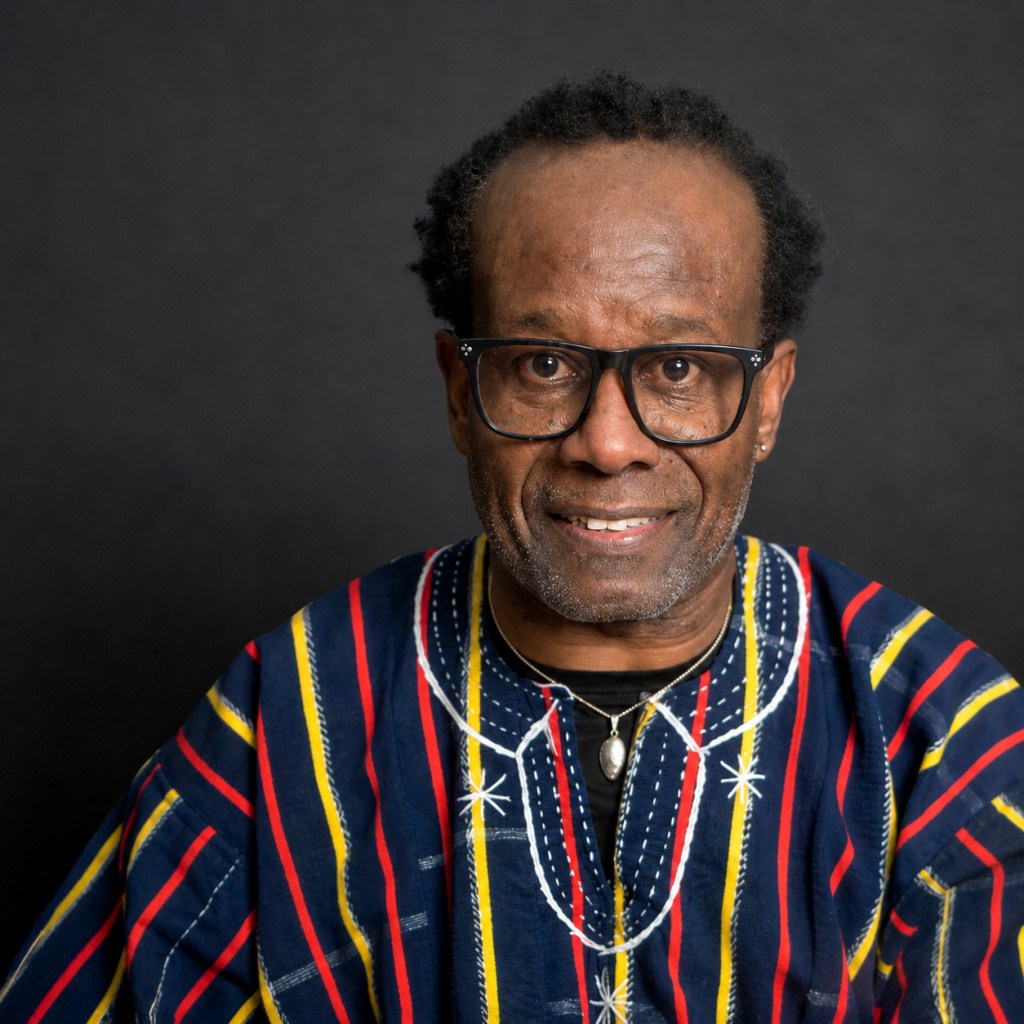
    Portrait of Dr. Omowale Elson, Founder and Chief Strategist of ECG Edge Academy and creator of the Pan-African Caribbean Youth Leadership Workshop.
    Dr. Omowale Elson
    Founder and Chief Strategist, ECG Edge Academy

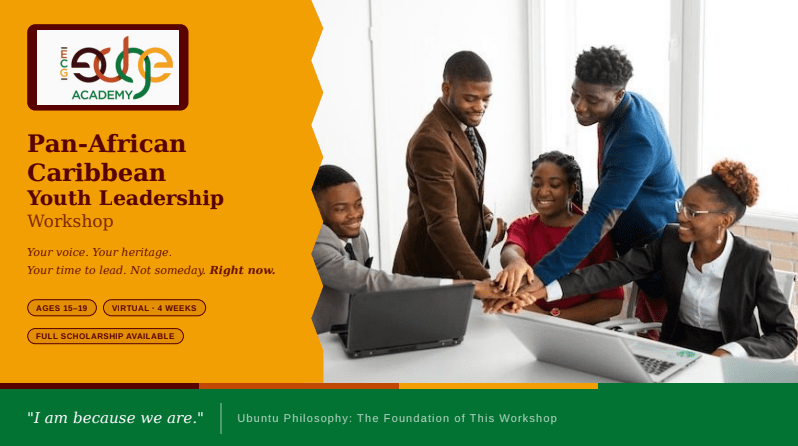
    It is for this reason that I was delighted to learn more about the Pan-African Caribbean Youth Leadership Workshop, developed by Dr. Omowale Elson and the ECG Edge Academy.

    Rather than offering leadership as a collection of techniques, the programme begins with a more fundamental question: Who am I?

    From there, participants explore how to find their voice, build meaningful relationships, and translate vision into action. Rooted in the philosophy of Ubuntu“I am because we are”—the workshop reminds young people that leadership is not merely about personal success but about uplifting others and strengthening communities.

    One statement in particular captured the essence of both the workshop and the vision of Ancestral Voices:

    “Your cultural heritage is not a barrier; it is your greatest leadership advantage.”

    That conviction speaks directly to our belief that healing begins when people rediscover who they are, embrace the richness of their heritage, and recognize the greatness that already lies within them.

    Investing in the Future

    At Ancestral Voices, we believe that one of the greatest investments any community can make is in its young people.

    Every generation inherits both the achievements and the unfinished work of those who came before. The question is whether we will equip our young people with the knowledge, confidence, and leadership skills to carry that work forward.

    The Pan-African Caribbean Youth Leadership Workshop offers one such opportunity.

    Over four weeks, participants are encouraged to reflect on their identity, strengthen their communication skills, learn to collaborate across cultures, develop practical leadership abilities, and connect with a growing network of peers throughout the African diaspora. More than a certificate, the programme seeks to cultivate thoughtful, confident, and purpose-driven young leaders.
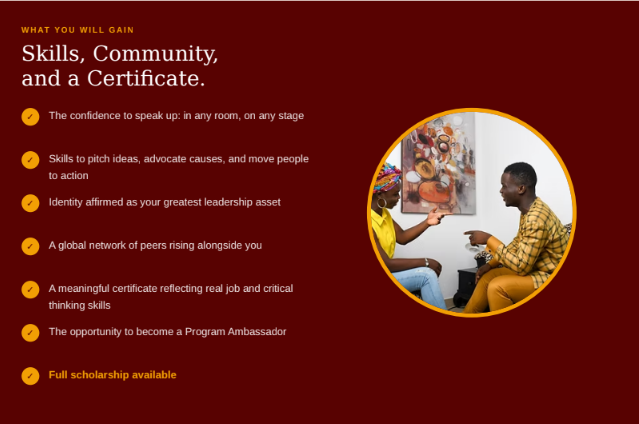
    Workshop benefits of the Pan-African Caribbean Youth Leadership Workshop, highlighting leadership skills, community, scholarships, and certification.
    Participants develop leadership skills, build community, and earn a certificate through the Pan-African Caribbean Youth Leadership Workshop. Graphic courtesy of ECG Edge Academy.

    At a time when many young people are searching for direction, initiatives like this remind us that leadership is not reserved for the future—it begins today.

    Why We Are Sharing This

    Ancestral Voices was founded on the belief that restoring our communities requires more than identifying problems. It requires recognizing, encouraging, and supporting the people and organizations that are actively creating solutions.

    That is why we are pleased to highlight the work of Dr. Omowale Elson and the ECG Edge Academy.

    Their commitment to developing young leaders reflects values that resonate deeply with our own vision of healing, restoration, leadership development, and the holistic advancement of people of African descent.

    We encourage parents, educators, youth leaders, churches, and community organizations to learn more about this initiative and to share it with young people who may benefit from the experience.

    When we invest in our youth, we invest in the future of our communities.

    When we strengthen the confidence, character, and leadership of one young person, we strengthen a family. When we strengthen families, we strengthen communities. And when communities are strengthened, nations are transformed.

    That is why initiatives such as the Pan-African Caribbean Youth Leadership Workshop deserve our encouragement and support.


    Learn More

    The Pan-African Caribbean Youth Leadership Workshop begins on August 3 and runs through August 30. The programme is conducted online, making it accessible to young people across the Caribbean and the wider African diaspora. Full scholarships are available for eligible participants.

    To register or learn more about the workshop, click below:

    Register for the Pan-African Caribbean Youth Leadership Workshop


    About Ancestral Voices

    Ancestral Voices is dedicated to promoting healing, restoration, leadership, education, and cultural renewal among people of African descent. We believe that lasting transformation is achieved not only by confronting the wounds of the past, but also by investing in the promise of the future.

    Through thoughtful dialogue, storytelling, research, and strategic partnerships, we seek to highlight individuals and organizations whose work is helping to build stronger families, healthier communities, and a more confident and empowered African diaspora.

    Because the future we desire will not happen by chance.

    It will be shaped by the leaders we prepare today.


    Editor’s Note

    This article marks the beginning of an ongoing Ancestral Voices Partnership Series, highlighting individuals, organizations, and initiatives whose work contributes to the healing, leadership development, education, cultural renewal, and holistic advancement of people of African descent throughout the African diaspora.

    We believe that meaningful change is achieved not only through ideas, but also through collaboration. By sharing stories of people and organizations making a positive difference, we hope to inspire others, strengthen networks of purpose, and encourage collective action toward a more just, confident, and empowered future.


    The views expressed in this article are those of Ancestral Voices. This feature is an independent editorial endorsement based on our assessment of the programme and its contribution to youth leadership development within the African diaspora.
  • We are not here to fight history — we are here to heal from it.

    For generations, confrontation, resistance, and ongoing antagonism framed the struggle for Black liberation. That struggle was necessary. It was righteous. We had every right to be outraged.

    But struggle alone is not healing.


    We survived enslavement.
    We survived colonialism.
    We survived displacement.
    We survived cultural erasure.

    But survival is not restoration.


    We have been walking forward while bleeding — believing resilience alone is transformation.

    Our ancestors carried trauma in silence.
    And we inherited their wounds.

    That inherited pain became an unfinished story — moving from plantation trauma to colonial neglect, and then into modern systems that still cannot fully protect, nurture, or uplift Black lives.


    Unhealed pain turns inward.

    It becomes:

    • Anger without direction
    • Grief without language
    • Trauma without release

    Today, that unspoken suffering shows up as:

    • Violence among young Black men
    • Addiction and self-destruction
    • Fractured families
    • Emotional numbness
    • Chronic illness
    • Identities shaped by pain rather than purpose


    Our young men are imploding under the weight of an inheritance they never asked for — internalizing trauma as violence, crime, drug abuse, self-hatred, illness, and emotional disconnection.

    Not because they are “lost.”
    Not because they are “bad.”

    But because we have never created a collective path to healing.


    We cannot continue like this.
    We cannot pass this inheritance to another generation.

    The cycle must be broken.


    Yet our society has never built a national healing project:

    No collective therapy.
    No cultural restoration strategy.
    No communal pathway back to wholeness.


    Too often:

    • Political leadership has failed to offer this vision.
    • Institutions have failed to provide it.
    • And we have failed to demand it with unity and clarity.

    It is time to build what never existed.

    Healing requires a different posture:

    Not war — but introspection.
    Not rage — but remembrance.
    Not silence — but truth.
    Not shame — but dignity.


    Healing is movement.

    And movement must begin now.


    This is the work of Ancestral Voices.

    A space where we reconcile with history without being imprisoned by it.

    Where we honour our ancestors — not by endless struggle — but by becoming whole.

    Where we stop waiting for transformation and begin embodying it.


    I am Douglas Newton.
    This is Ancestral Voices.

    The time to heal is now.


  • They speak to me in the night —
    voices older than mountains, carrying the weight of centuries.
    They call me to remember.
    To rise.
    To rebuild.


    I am not a Klingon battle cruiser tearing across space,
    chasing honour through blood and battle.

    I am a wounded spirit learning that
    healing, too, is a form of courage.


    I am not a Romulan Bird of Prey decloaking on a mission of vengeance.

    I am a broken spirit choosing to live —
    and learning that peace requires more bravery than war.


    Ah — but I…
    I am a Federation starship.

    I bring:

    Peace.
    Healing.
    Reconciliation.

    I am here to rebuild the shattered spirits
    of those uprooted from their homeland.


    Yes — I who once sailed antiquity,
    who built glorious civilizations,
    who formed the bedrock of humanity —

    now I weep.


    Why?

    Why am I shipwrecked upon jagged isles
    of social, moral, and spiritual decay?


    Why is violent crime so rampant
    among my young Black men?

    Why does my blood
    run the streets like water?


    Don’t I know I owe it to myself
    to become the best I can be?

    Don’t I know I cannot blame others
    for my current circumstances?

    Don’t I realize my ancestors look upon me,
    praying that I will go farther than they could —
    because I hold opportunities
    they never had?


    So instead of death-trips on false codes of honour
    and confused ideas of manhood…

    Should I not honour the memory
    and legacy of our ancestors —

    and pull this mighty ship
    off the rugged reefs
    of crime and violence?


    There is no reason
    this vessel should be sinking today —
    not a ship as ancient and majestic as ours.


    Ah yes, even great ships sink.
    The Titanic — the marvel of her age —
    sank on her maiden voyage.

    But our ship is built of something stronger:

    Resilience.
    Peace.
    Integrity.
    Love.


    No iceberg can sink this ship.


    So lift up your heads, you ancient gates —
    lift them up, you eternal doors —
    that the King of Glory may come in.


    Let us rebuild this great Black ship.

    Let us restore her:

    Honour.
    Integrity.
    Valour.


    Let us create a new future
    for the Black race —
    and for humanity as a whole.


    I am Paulos —

    Your Chosen Vessel.


    Douglas Newton

    The Eagle Has Landed
    New Horizons to Pursue — New Mountains to Climb


  • “People do not judge the measure of a man by his accolades, but by the quiet dignity of how he carries himself and the honour with which he serves others.” — Douglas Newton

    I first met President The Most Honourable Jeffrey Bostic in the early 1980s, while he served as aide-de-camp to then Governor General Sir Hugh Springer.

    I had just joined the Barbados Advocate as a freelance photographer. The news editor, Mr. Eric Smith, sent reporter Michelle Arthur and me on an assignment to Government House, where Sir Hugh was hosting a reception for local and international dignitaries — ambassadors, high commissioners, and United Nations delegates.

    I wanted to capture a photograph of the Governor General in conversation with some of his distinguished guests — the High Commissioners of Canada and the United Kingdom. As a newcomer, I was unsure how to proceed with protocol. I noticed an immaculately dressed officer standing a short distance away and quietly asked Michelle, “Who is he?”

    She whispered, “That is Captain Jeffrey Bostic, the Governor General’s aide-de-camp.”

    Wanting to do things properly, I approached Captain Bostic and explained what I hoped to photograph. He smiled warmly, then personally escorted me over to Sir Hugh and made the introduction on my behalf.

    The Governor General graciously agreed, and I captured the photographs. As we finished, Sir Hugh looked at me, smiled, and said, “You are a very conscientious young man.” I thanked him — and later that evening went home and looked up the word conscientious in the dictionary.

    Captain Bostic would go on to rise through the ranks of the Barbados Defence Force, advancing from Captain to Lieutenant Colonel and eventually to Colonel. Throughout his military career, he guided countless recruits in the true spirit of service and love of country. He also provided leadership that helped preserve national security — not only for Barbados, but as part of the Regional Security System.

    Transitioning from military service into national leadership, Colonel Bostic entered politics and was elected to Parliament to represent the constituency of the City in the 2018 General Election. These were new horizons, yet he met the challenge with the same poise, grace, and dignity that have always characterized the man.

    As a parliamentary representative, he went beyond the call of duty to serve the people of the City faithfully. When he assumed the portfolio of Minister of Health, Colonel Jeffrey Bostic brought decisive leadership and high standards of management to the ministry, particularly during the unprecedented challenges of the COVID-19 pandemic, when Barbados and the world confronted one of the most daunting public health crises in modern history.

    All Barbadians showed their love for this man, as evidenced by the outpouring of sentiment when they learned he was a candidate for this high office.

    Mr. President, you have had a long and distinguished career in service to Barbados — a record that stands as an inspiration to us all.

    Our nation could not have made a more fitting choice in entrusting you with the highest office in the land.

    It is also significant that your public journey began at the side of Sir Hugh Springer — himself a statesman and a gentleman — a formative experience that prepared you well for the responsibilities you now hold.

    President Bostic, I join all Barbadians in congratulating you as you assume the office of Head of State.

    I wish you abundant health and continued blessings as you carry forward this new tour of duty — for love of country, and for service to country.


    Douglas Newton

  • Why We Need Ancestral Voices

    “A people without knowledge of their past history, origin, and culture is like a tree without roots.”
    Marcus Mosiah Garvey


    Introduction

    When I’m asked what Ancestral Voices is, I begin by saying it is not merely a blog or a project — it is a movement of remembrance and restoration. It was born out of a growing awareness that too many of our people, especially the younger generation, are walking through life disconnected from the wisdom and dignity of their ancestry, and wounded by unhealed history.


    Why We Need Ancestral Voices

    We have advanced in education, technology, lifestyle, and housing — but we have not healed. The spiritual and psychological damage of slavery and colonization still echoes through our societies, shaping our homes, our schools, and our streets. Progress without healing has left us functional, but fractured.

    For generations, we have been taught to measure advancement in material terms while avoiding the deeper work of restoration. We built systems, institutions, and careers, yet left unresolved the inherited wounds that continue to surface as anger, disconnection, violence, and despair. What we avoided naming did not disappear; it simply found other ways to express itself.

    Ancestral Voices exists to help us face those wounds — to name them honestly and to begin the long work of healing. This is not about blame or grievance. It is about truth, memory, and accountability. Healing cannot begin where silence is treated as peace, or where discomfort is avoided to preserve social harmony.

    This work is not abstract for me; it emerges from a long, learned silence — one I have written about elsewhere.

    We are the dream of those who endured, and the hope of those yet unborn. Our responsibility is not only to remember, but to rebuild — to speak with honesty, to act with conscience, and to create a future no longer governed by unhealed pain.


    A Personal Awakening

    For years, I carried this message quietly inside me — afraid of my own voice, uncertain of how the world would receive it. But silence has its own cost. I have come to realize that healing begins when we speak, when we remember, when we tell the truth with love and conviction.

    We must let go. We must move on. We must heal from the wounds of plantation slavery. We must begin again.

    There are some who may not want to hear the words ‘let go.’ But they are not words of dismissal — they are words of liberation. The only way we can build a better future for the Black race, for our families, for our world, is if we have the courage to say: This is enough.

    We must let go. We must come together. We must heal. We must rebuild.

    This is the message I carry for Black people — and for humanity. My time is now. This is my blessed season.


    The Work Ahead

    Through essays, conversations, and community storytelling, Ancestral Voices will connect history with the present. It will draw from philosophy, the Bible, oral tradition, and lived Caribbean experience to answer one question: What must we do to heal as a people?

    I believe the answer begins with listening — to the ancestors, to each other, and to the conscience of our times.

    “We are the dream of those who endured, and the hope of those yet unborn. Our duty is to remember, to awaken, and to rebuild.”
    — Douglas Newton

    — Douglas Newton
    Founder, Ancestral Voices

  • Afraid of My Voice

    October 17, 2025
    Founder’s Reflection #1

    Dedicated to all who have ever been silenced, yet still believe in truth, dignity, and renewal — may you find your voice, your peace, and let your light shine.

    For many years, I carried a truth in my heart and was afraid to speak it.
    Not because I doubted its validity, but because I understood the cost of speaking openly about slavery, race, and identity in Barbados.

    From an early age, I learned that these were subjects best left untouched. Those who raised questions about the legacies of slavery or the inequalities shaping our lives soon learned that these were not conversations to be had — not if you wanted to remain acceptable, employable, or undisturbed. You could be labelled divisive, even accused of racism yourself, simply for naming Black history or calling for moral and economic justice.

    I name this carefully, not to catalogue grievances, but to describe the climate in which silence was learned and sustained.

    To speak too plainly was to risk being branded a troublemaker, or worse, to be quietly sidelined. The ruling class — the old plantocracy and their descendants — preferred silence, and much of the political class followed that lead. The message was rarely spoken outright, but it was widely understood: that was a long time ago; let it rest; move on.

    Quiet was offered as harmony — a reassurance that if we kept still, everything would remain orderly, manageable, and acceptable.
    Silence was presented as peace.
    In truth, it was paralysis.

    Look at the violence among our young Black men — sixteen and seventeen-year-old boys now being accused of robbery and murder. This did not come from nowhere. It is a direct byproduct of our silence, our refusal to confront the legacies of plantation slavery, and our failure to build any structured programme for national healing.

    Our young men are not bad. They hurt. They are broken. They are bleeding. This is the chickens coming home to roost. And if we do not act with honesty and courage, the haemorrhage will continue.

    Yet even in that paralysis, many of us in the arts — in dance, drama, music, and folk performance — kept the culture alive through rhythm, movement, and story. Long before there was language for trauma or public space for reckoning, culture carried what could not be spoken. It preserved memory where institutions failed, and dignity where history had been denied.

    Yet there was no sustained or organized effort to address the psychological wounds of plantation slavery, nor to confront the systems that allowed those wounds to persist. Calls to teach African history in our schools surfaced from time to time, but they were routinely deferred, diluted, or dismissed. The story of our ancestors was treated as optional — as though it were an elective, and not the foundation of who we are.

    That silence shaped me. Over time, it taught me to question the worth of my own voice — especially because I was not a doctor, a lawyer, or an academic. In our society, authority is often conferred by titles and credentials, while artists are expected to justify their presence, their insight, and even their right to speak. Unless they achieve international recognition, they are frequently dismissed as dreamers — visible, perhaps, but not substantive.

    I absorbed that message quietly. It made me hesitate, second-guess, and measure my words against standards shaped by someone else’s idea of who I was meant to be.

    Rihanna’s success is often held up as proof of what is possible — and rightly so. She has brought pride and visibility to Barbados on a global stage. But not every path is paved with international access, corporate backing, or global platforms. For many of us, the struggle has never been for fame, but for legitimacy — for the simple right to speak, to be heard, and to be taken seriously in our own country.

    That is why Ancestral Voices exists. Not as a campaign or a slogan, but as a commitment — to reclaim memory, to affirm dignity, and to create space for truths that were long discouraged or denied. It is my refusal to continue mistaking silence for stability, or quiet for consent. It is the moment I chose to stop measuring my voice against systems that never intended to hear it.

    When I say we must let go, I am not speaking of forgetting. I am speaking of release. Letting go is not dismissal; it is liberation. It is the choice to face our history honestly, to grieve what was lost, and then to refuse to let unhealed pain govern our future.

    I may not carry a title, but I carry a voice — one shaped by history, silence, and resilience. And that voice now speaks not in anger, but in conviction. It says that we can remember without remaining bound, acknowledge without being consumed, and move forward without erasing who we are.

    We must come together. We must let go. We must heal. And from that healing, we must rebuild.

    This is not the end of silence — it is the beginning of voice.

    — Douglas Newton